


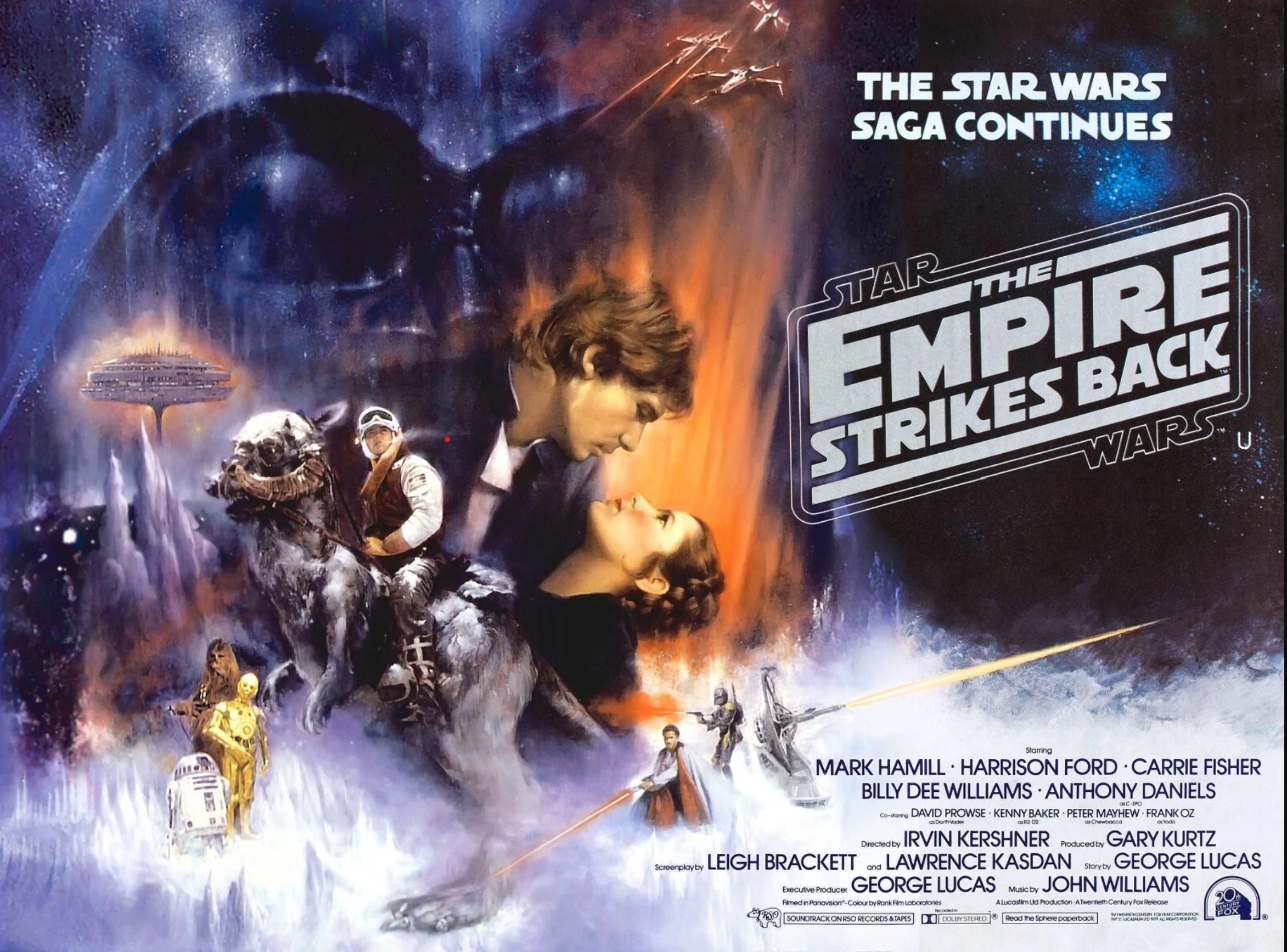
In the climactic scene of 1980’s The Empire Strikes Back, something magical happens that most people don’t notice.
Our hero, Luke Skywalker—the knight-in-training, whose journey from farm boy to galactic savior was the spine of the excellent Star Wars: A New Hope—is bloodied and beaten. He’s also bereft of a right hand, it having just been severed by his arch nemesis, the galactic tyrant Darth Vader. The ensuing scene is one of the most famous in all of American cinema, containing a plot twist that immediately etched itself into pop culture legend for generations.
But while the scene remains a thrilling climax after nearly two hours of peerless storytelling, the true magic is what happens right after it.
Having spent the film running away from himself, Luke now has nowhere else to run. He has been forced to confront a dark reality, shattered by the knowledge of his true identity and lineage. Clinging with his good arm to a platform suspended above an abyss, he gazes down into the oblivion beneath him. He looks back at Vader, who with an outstretched arm offers the hero not only escape from certain death, but power beyond all imagination. But Luke rejects the offer, and lets go.
He falls into the void, seeming not to care what happens to him. This is what a suicidal person does—they’ve given up caring whether or not they live. But there is something deeper at work: The Empire Strikes Back is, after all, a fairytale, according to its director. There is a lesson embedded in Luke’s decision that penetrates beneath what is seen onscreen.
It’s this moment that makes The Empire Strikes Back the standout film of George Lucas’ beloved Star Wars trilogy, and allows it to transcend classification as merely a “science-fiction action-adventure.” It is this moment which speaks to something deep within the human struggle, and which ultimately elevates The Empire Strikes Back into a timeless classic.
Star Wars: A New Hope opened in limited release May 25th, 1977, and quickly became a national sensation.
By July of 1978 it was still running in some theaters, and demand was so high that it was eventually restored to over 1,700 additional houses. The film was made for $11 million, but grossed far north of a quarter of a billion in its first run. George Lucas, the film’s creator and director, had become an overnight success. Of course came demands for a sequel. But how in the hell do you repeat the success of the biggest movie ever?
Easy:
You don’t try.
Having no desire to direct the sequel, Lucas offered the massive undertaking to Irvin Kershner, who’d taught him at USC. Kershner was an unconventional choice, not experienced in the world of fast-paced, sci-fi space action cinema. But he was indisputably Lucas’ best hire: “you know everything a Hollywood director is supposed to know,” Lucas is said to have told Kershner, “but you’re not Hollywood.”
Raiders of the Lost Ark screenwriter Lawrence Kasdan—brought on board after sci-fi legend Leigh Brackett fell too ill to see the project through—echoed Lucas’ assessment of Kershner’s uniqueness:
“[Kershner] was an enormous influence on everything because he was such an unusual, eccentric character…He had made New York gritty human adult dramas before [The Empire Strikes Back]. And when his name was announced to do the second Star Wars people were amazed. You couldn’t understand it.”
Kershner had the whimsy and wisdom to see The Empire Strikes Back not as science fiction, but as fairytale. Science fiction requires jargon, Kershner believed, and is more niche. But fairytales are familiar to all: archetypal light and dark figures; heroes leaving the safety of home base; a voyage into darkness; brushes with almost certain death; helpers (Yoda and R2D2) and tricksters (Lando Calrissian); and, finally, a moral lesson. Each element—especially the last, as we shall see—is woven into The Empire Strikes Back, lending the work a universality and timelessness that moves it beyond the boundaries of “space action movie.”
Of course there are still laser battles, spaceships, aliens and explosions. The technical wizardry on display—from lifelike puppetry to groundbreaking special effects—is more impressive than the offerings in A New Hope. So astonishing are they that even 45 years later the film feels more “real” than the latest CGI-laden extravaganzas.
But impressive as the technology is, the most memorable moments in The Empire Strikes Back are psychological, and its biggest explosions are emotional.
One need only examine the film’s structure to appreciate Kershner and Kasdan’s de-emphasis on frenetic action: the climax in A New Hope is the spectacular Death Star raid in the third act; but the imperial blitz on the rebel base on planet Hoth is the major action set piece in The Empire Strikes Back, and is unleashed just 20 minutes into the film. The climactic scene is not an epic clash between awesome spacecraft, but the tense and methodically-paced duel between Skywalker and Vader.
Kershner and Kasdan are not “going bigger” for the sake of a sequel, but going deeper, into the human beings and relationships at the heart of the story.
To Kasdan, “the whole [Star Wars] saga is about ‘are you in touch with the feelings that are swirling around you.’” But this is only part of The Empire Strikes Back’s magic:
For the underlying question of the film is whether or not you are in touch with the feelings within you.
The plot is bifurcated but uncomplicated; its theme is retreat.
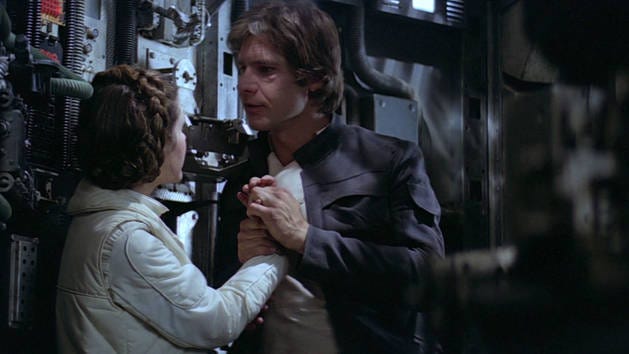
One plot involves the rakish Han Solo and stately Princess Leia Organa retreating from Vader and the evil Empire. But the story is about the failure of the pair to escape each other. The tragedy is that soon after the pair fall into each other’s clutches, the plot intervenes and forces Solo into the Empire’s clutches. The love that buoyed the film with levity and warmth is destroyed once Solo is frozen in carbonite.
Harrison Ford’s Solo is in full command of the first half of the film. Arrogant, decisive, disagreeable, and yet usually right, he’s effortlessly engrossing because he neither hides nor apologizes for his rough edges. Unlike Luke, Han is no stranger to the darkness within him, and has made peace with it. Yet he still has room to grow: only a woman’s touch can bring him to full maturity and make him whole.
Carrie Fisher, so memorable as a sexpot in her screen debut in the Warren Beatty vehicle Shampoo (1975), employs sharpness and grit as Leia. She is the ideal foil to Solo’s bravado, her coldness cutting through him in a way that even the Empire’s worst can’t manage.
Yet the film announces that she is drawn to him within its first few scenes. We know instantly that the two are destined for each other. It is Solo’s masculine desire and bravado that tests and ultimately melts Leia’s steely demeanor—a natural consequence of being surrounded by men during wartime—and enables her softness to emerge.
The power of Han and Leia’s story lies in their inability to resist one of humanity’s most powerful binding forces, whatever the impracticality. Structurally it also provides levity to balance the darker elements of the movie’s central story: the death and rebirth of Luke Skywalker.
Where Han and Leia seek retreat from the Empire—and, for a time, from each other—Luke’s story serves as a warning of the consequences of retreating from one’s Self.
The second act of The Empire Strikes Back begins with Luke Skywalker, having escaped from the ice planet of Hoth, crashing his X-wing spacecraft into the marshes of the swampy planet Dagobah. His ship sinks fully into the quagmire. For now, there is no turning back.
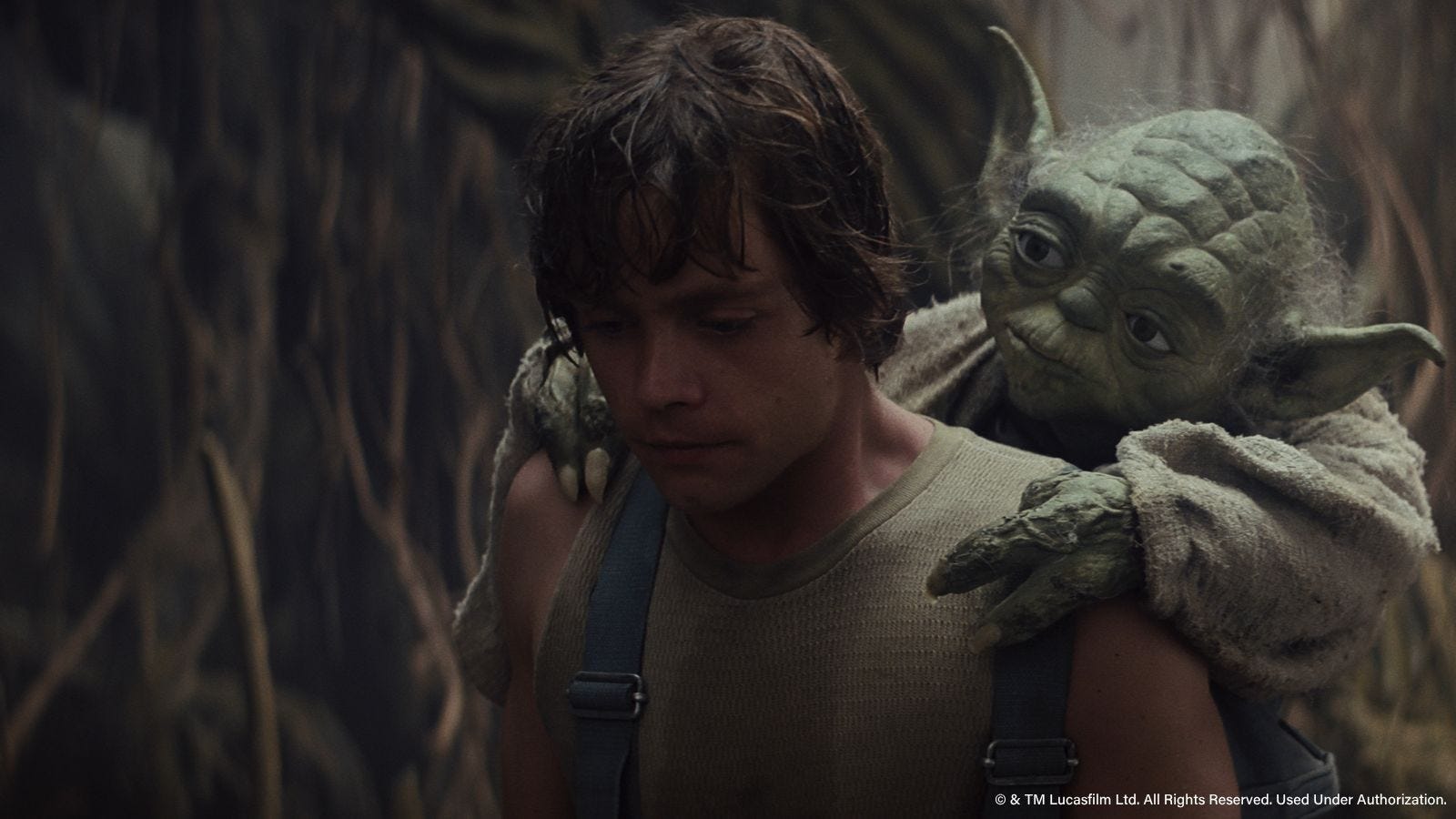
While taking stock of his environment he happens upon a strange and annoying creature, who rifles through his belongings and makes himself a nuisance. Of course, this is all a test by Jedi Master Yoda, brought vividly to life by voice actor Frank Oz and a crack team of puppeteers. Yoda intuits right away that Luke is in disarray.
Dagobah’s muddiness and murk is the perfect metaphor for the lack of clarity in Skywalker’s soul. When asked why he wants to become a Jedi, he doesn’t really know—“because of my father, I guess,” he replies, unwittingly foreshadowing a startling revelation. Skywalker may have been a galactic savior in A New Hope, but the sequel is soon to deliver a brutal lesson in how far he has to go before he can truly become whole.
For all his potential, Luke is still impatient, petulant, and whiny. His mind is cluttered, never focused on the present, and his mindset trends toward the negative: in contrast to Han Solo, who famously says “Never tell me the odds,” Yoda recognizes that with Luke “always with you what cannot be done.” He’s a force of light, but has yet to face the darkness within himself. And that makes him unbalanced, unfocused, and ultimately weak.
As such, Luke cannot become who he is truly meant to be until he is crushed by Darth Vader.
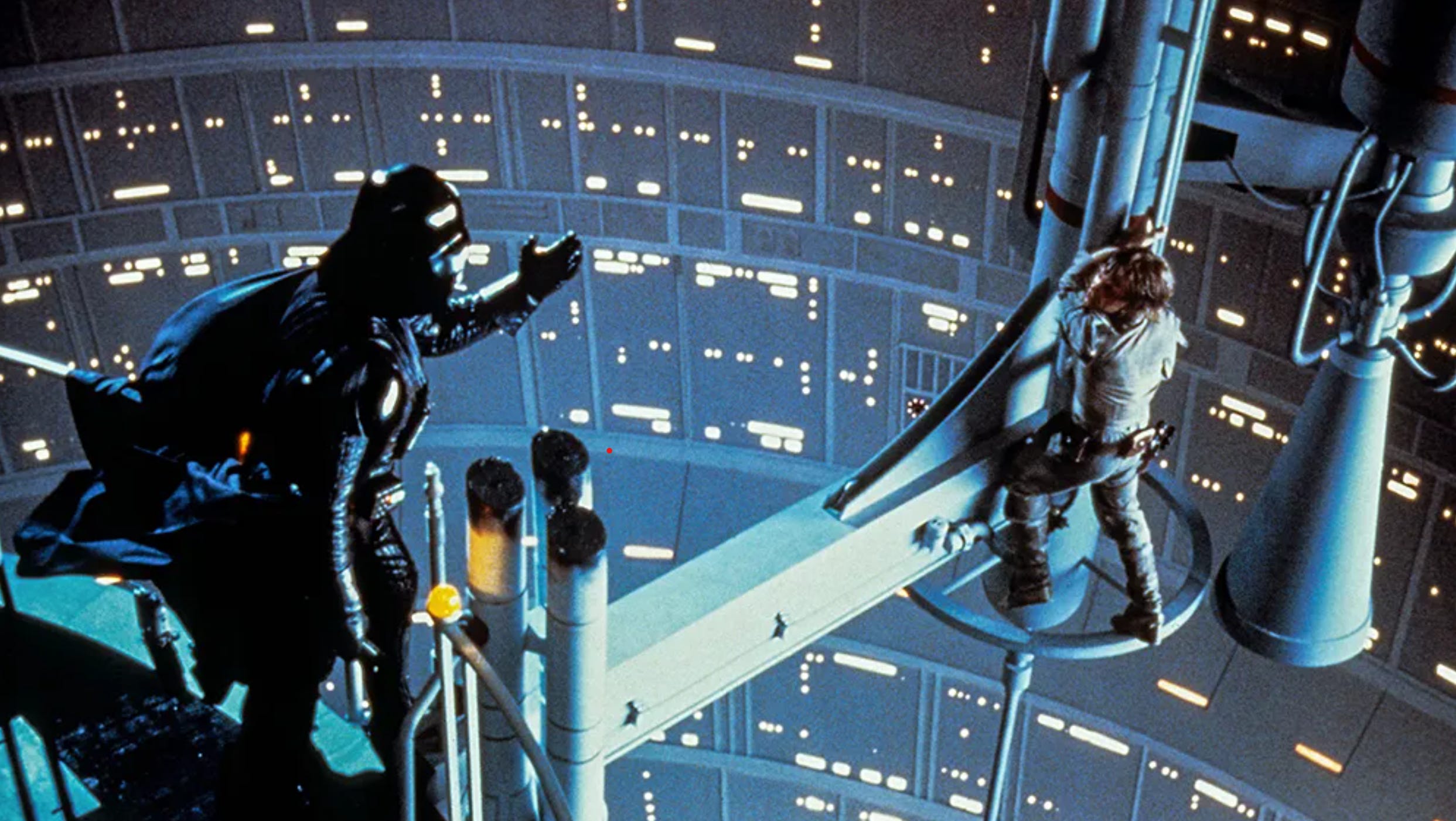
Luke’s defeat is the moment when the impetuous, naïve, reckless, immature boy is finally vanquished. He lets go in despair, likely expecting to fall to his death—but instead he is saved.
It is only once Luke is at his absolute bottom, barely clinging to life, that he is finally able to clear his mind—as Yoda has been trying to teach him to do—and find the focus required to communicate across the ether to Leia. It is only after having passed through Hell that he begins to tap into the true powers of “the Force.”
The film’s cliffhanger ending is characterized as dark, but in fact it is the start of a new journey. It is only after reaching his lowest point and surrendering completely that Luke has a chance to rebuild himself (he is immediately given a new hand to replace the one he’s just lost). A new voyage is beginning, a new season of life. Luke is now embarking on the journey to full integration.
His inner struggle to access his true potential, his avoidance of the work that would bring him to full power, his cowardice in the face of his fears—each strikes a chord with anyone stumbling along the path to personal growth and maturity. His suffering is our suffering, his mistakes are our mistakes. But when at his darkest moment Luke is finally rescued, that is the moment The Empire Strikes Back transcends and takes on a spiritual dimension, offering a life lesson to those open to receiving it.
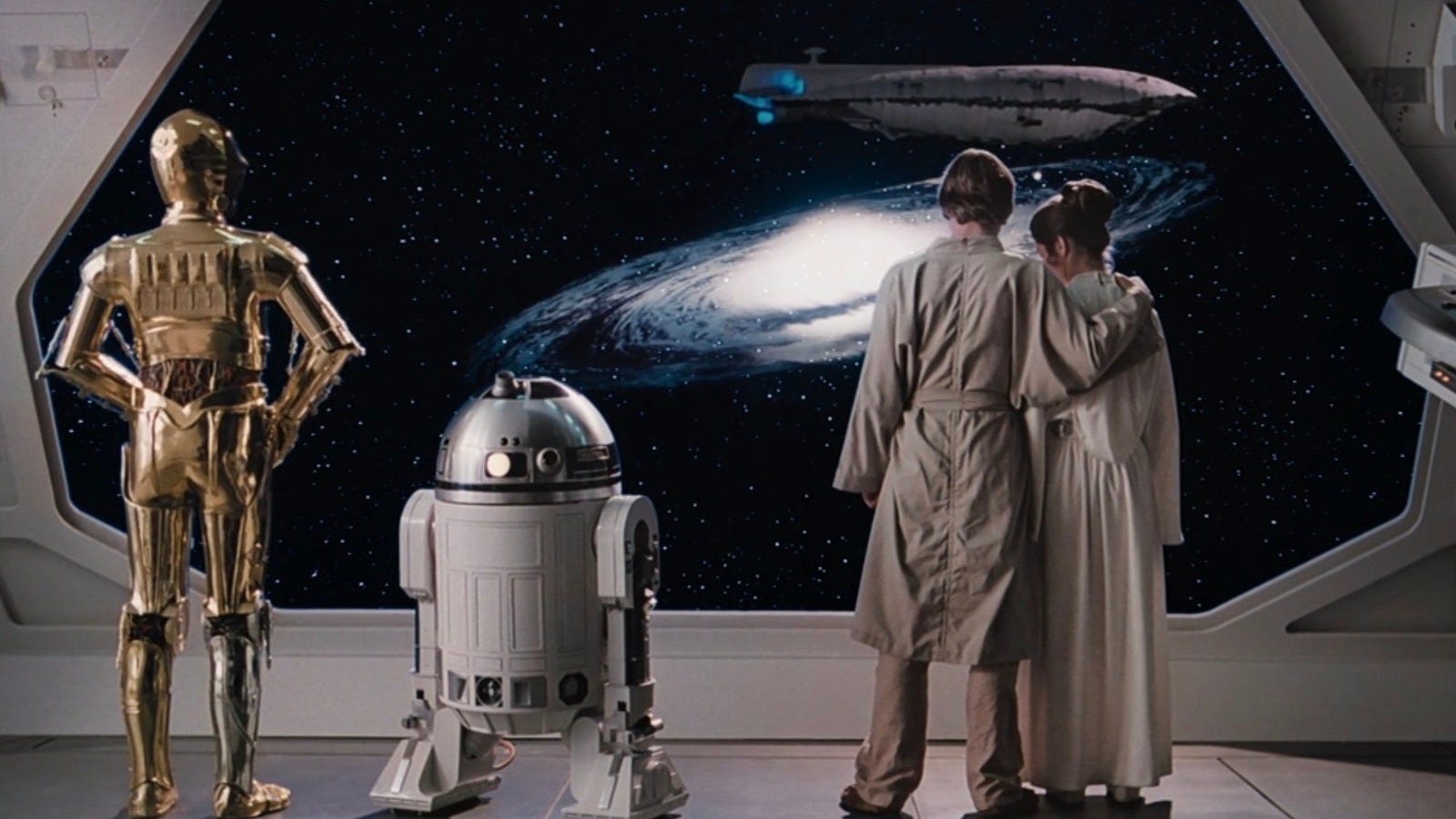
Only on the surface does the film end in darkness. Its ending contains the seeds of renewal, the idea that life will still go on, and that the journey must continue. The final shot is Luke and Leia standing together, reunited after having survived tremendous hardship, gazing out into the stars—a void pregnant with possibility.
In this sense the film ends with a cautious optimism.
It ends with a new hope.
This is the story underneath, of tragedy and the possibility of redemption, that—combined with incredible technical genius—makes The Empire Strikes Back a classic.
CD
First off, I loved this piece. It made me excited to read it and it left my imagination churning.
To that end, I would offer a take that occurred to me while reading this fantastic piece:
There’s another structural element at play. It’s that the film is bookended by a pair of near-death experiences by Luke. In the ice cave against the Wampa, Luke is able to focus, and channel the force to retrieve his lightsaber. And then what does he do? He CUTS OFF THE WAMPA’S ARM.
Moreover, it’s important to note that while Luke may have called out to Ben Kenobi, it’s Obi-Wan who reaches out to him.
And yet this near-death experience really doesn’t change Luke.
Instead, it’s Luke’s abject failure against Darth Vader that changes him. It’s having HIS arm cut off that changes him (literally and metaphorically).
Then, after escaping death a second time, it’s Luke’s actual father who replaces the father figure of Obi-Wan.
This new dynamic is cemented when Luke receives his new robot arm - just like Dad.
But unlike the Wampa cave, this time we see that Luke is changed. And because of that, the film ends with hope.
Love every word of this post. Thank you for elevating a work of art that often gets overlooked.
There is another seed of cautious optimism and a new hope and it might be my favorite scene in the whole movie.
As Luke just leaves Dagobah prematurely, Obi-Wan says, “That boy is our last hope.” Yoda replies, “No… there is another.” That single line, paired with the shifting light on Yoda’s face, plants the perfect seed of cautious optimism. Like you said, even in apparent defeat, the fairytale renews. Gives me goosebumps every time.