


On various social platforms you’ll find accounts decorated with images of cathedrals and Bernini sculptures, asking “Why don’t we build beautiful buildings like this anymore?” or “Why is everything so ugly now?” I used to appreciate such content; lately it’s grown tiresome.
I’m not a soulless cretin; one should stay woke to Beauty’s oppression. Ours is a society where taste has been filched from a range of sectors, from pop culture to politics. Even having standards of Beauty is offensive in some circles. As churlish as the enemies of beauty may be, however, I now see among Aesthetic Justice Warriors strains of—let’s call it “kalomania”1—that are not only tiresome, but tyrannical.
Of course beauty matters. We’ve all seen the Roger Scruton film. But what separates the kalomaniac from the Scrutonian is lust for control. The Scrutonian wonders why we don’t make more beautiful things; the kalomaniac wants to ban certain artists from making anything at all.
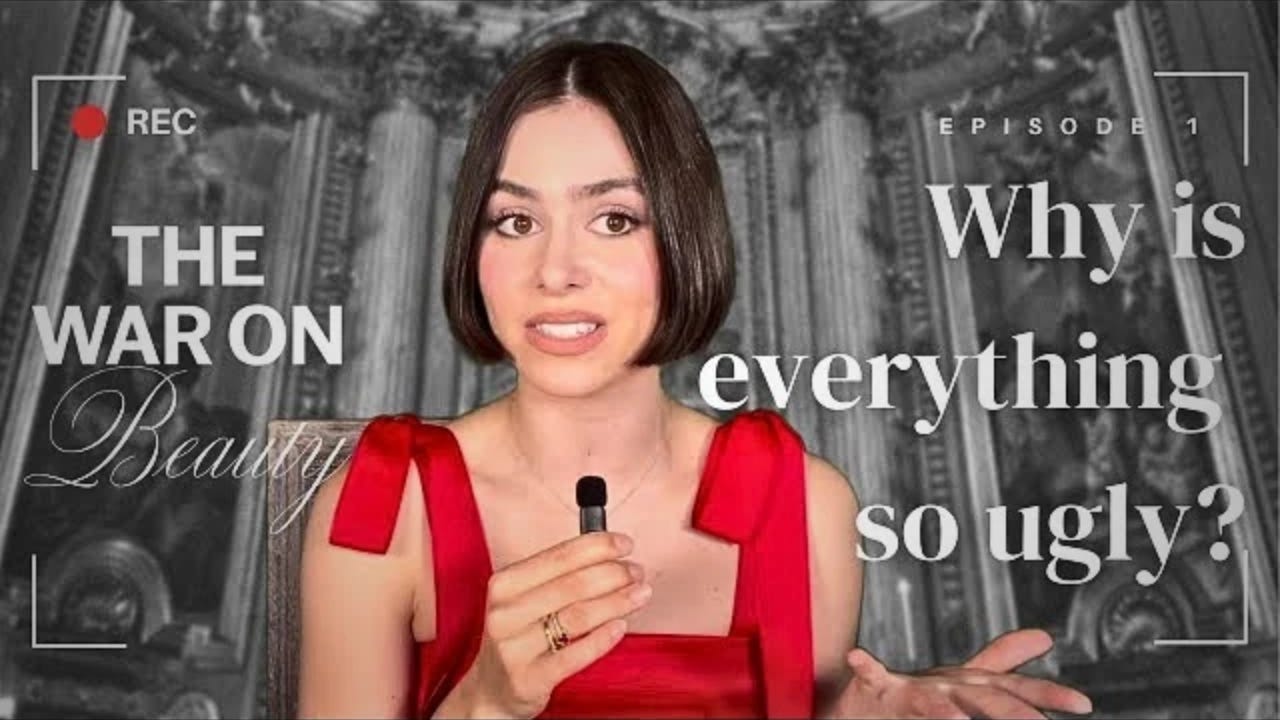
In November 2026, Julia James Davis–creator of the YouTube channel “The War on Beauty”–posted a tearful 10-minute video recounting a visit to an art exhibit that appears to have destroyed her. “This should be illegal!” blares her YouTube thumbnail. Surely, I muse, she’s employing hyperbole for the sake of clicks. She’s not actually advocating for artists to be arrested for offending her sense of decency, is she? No she isn’t and yes she is, respectively.
Through sobs and snot, Ms. Davis focuses on a singularly horrendous sculpture that greeted her upon entry to the exhibit: a naked figure on all fours, sporting an extended streak of black shit trailing from a bloody and bruised backside. It’s easy to see how Davis, whose Catholicism explicitly informs her vision of beauty and art, would receive the work, credited to Kiki Smith, as an act of “terrorism.”
Certainly, the sculpture’s aggressive anti-aestheticism is a manifestation of a deeply cynical creator, possessed by a dreary vision of mankind. But as traumatized as Ms. Davis seems to have been by the work, I found myself unmoved by her (ostensible) pain. As her video progressed my coldness turned to contempt. Finally I was shocked: any subscriber to the idea that yearning for aesthetic élan is a symptom of emergent fascism now has all the ammunition they need.
First, Ms. Davis pre-emptively rejects any defense of the sculpture, as though only a degenerate would defend it as a piece of “Art.” Yes, the piece is a tough sell. But must “Art” be only what one doesn’t deem sacrilegious? Can we not recognize Smith’s dreadful sculpture as, at minimum, a realization of her creative vision? If art’s primary power is emotional provocation, hasn’t the piece—which appears to have ravaged Ms. Davis so thoroughly that it’s unleashed her inner despot—brilliantly succeeded?
The FBI should raid the homes and hard drives of degenerates like Kiki Smith, cries Davis, who then demands that such offenders be punished for breaking decency laws (which, she takes care to point out, are still on the books in some places). Her followers are in accord, weighing in with allusions to Satan and grieving our societal rejection of Christ. Trudging through Ms. Davis’ replies one senses the flavor of fervor that drove the shuttering of English theatres in the 17th century, or the Satanic Panics of the twentieth.
Shall we reinstate the Hays Code or the Comics Code? Should comedians again find themselves arrested for words that mustn’t be said? Or will we accept that subversive and transgressive art will continue to be made as long as there are sensitivities to offend? And how have moral panics in reaction to the arts played out in the past?
The Restoration and the rise of celebrity “Actor-Managers” followed the reopening of London theatres. Hollywood became America’s biggest cultural export after the Codes were discarded. Comic books, videogames and rap music each flourished after failed attempts to police their content. Moral panics come and go. Art always wins—no matter how many practitioners are imprisoned.

Recently an NPR video popped up on my YouTube feed featuring rap group The Lox. As far as rap acts go, The Lox—and notable front man Jadakiss—aren’t especially consequential, despite their commercial success. Their “Tiny Desk Concert” nonetheless has over 3 million YouTube views as of this writing.
Ours is an unprecedented era for the enterprising Artist-Independent. There are podcasts on screenwriting, video essays on history’s greatest basslines, digital courses on painting and illustration, and webinars on making art one’s business. An international community of illustrators and writers are posting to platforms like Substack and X. Anyone, from South Korean rappers to Ghanaian dancers, can build an audience on Instagram or TikTok. YouTube remains a top resource for finding entire concerts, plays and operas. Hence my final gripe with the Beauty Blackpill Brigade: most are focused on creating content, few have interest in creating culture.
This isn’t for lack of talent. There are many like-minded, top-class creatives who share Ms. Davis’ and others’ despair over the state of our cultural institutions (and by extension our society). But they are stuck—shut out of the industries where their talents should be properly embraced, and ghettoized within a milieu which has no interest in building infrastructure to support them.
To her credit, Ms. Davis has announced a “War on Beauty” tour for 2027. There appear to be no specific dates, nor artists lined up other than her brother (a musician). Organizing such an endeavor is difficult; I applaud her efforts, even if she is firing before readying and aiming. Whatever my dispute with her vision, we agree the world needs more beauty.
But the arts do not need more dictators—no matter how earnest they may be.

Inspired by the Greek kalos, for “beauty.”
At the end of the day, there is only one thing art should be, and that is free. Even bad art is art, and bad artists should be free to do their bad art.
Didn’t we go through this in the 90s? (See Piss Christ. NEA4. Cincinnati Contemporary Arts Center/Mapplethorpe). And in literature decades before that? (See Ulysses. Madame Bovary).
I mean, I’m not clicking on that woman’s anything, I’ll take your word. And I haven’t viewed the actual piece of art to which she has lost her own shit (sorry, too soon?). But I am a gay man who has, perhaps more than once in my life, experienced an accident in the bedroom so I’m offended that she is attempting to erase me; dismiss my reality; other me. She needs to make space for my bloody shitty ass on all fours.
(sorry … too much?? How dare you!)