


If New Yorkers were truly smarter than everyone else, they’d quit electing people who are dumber than everyone else.
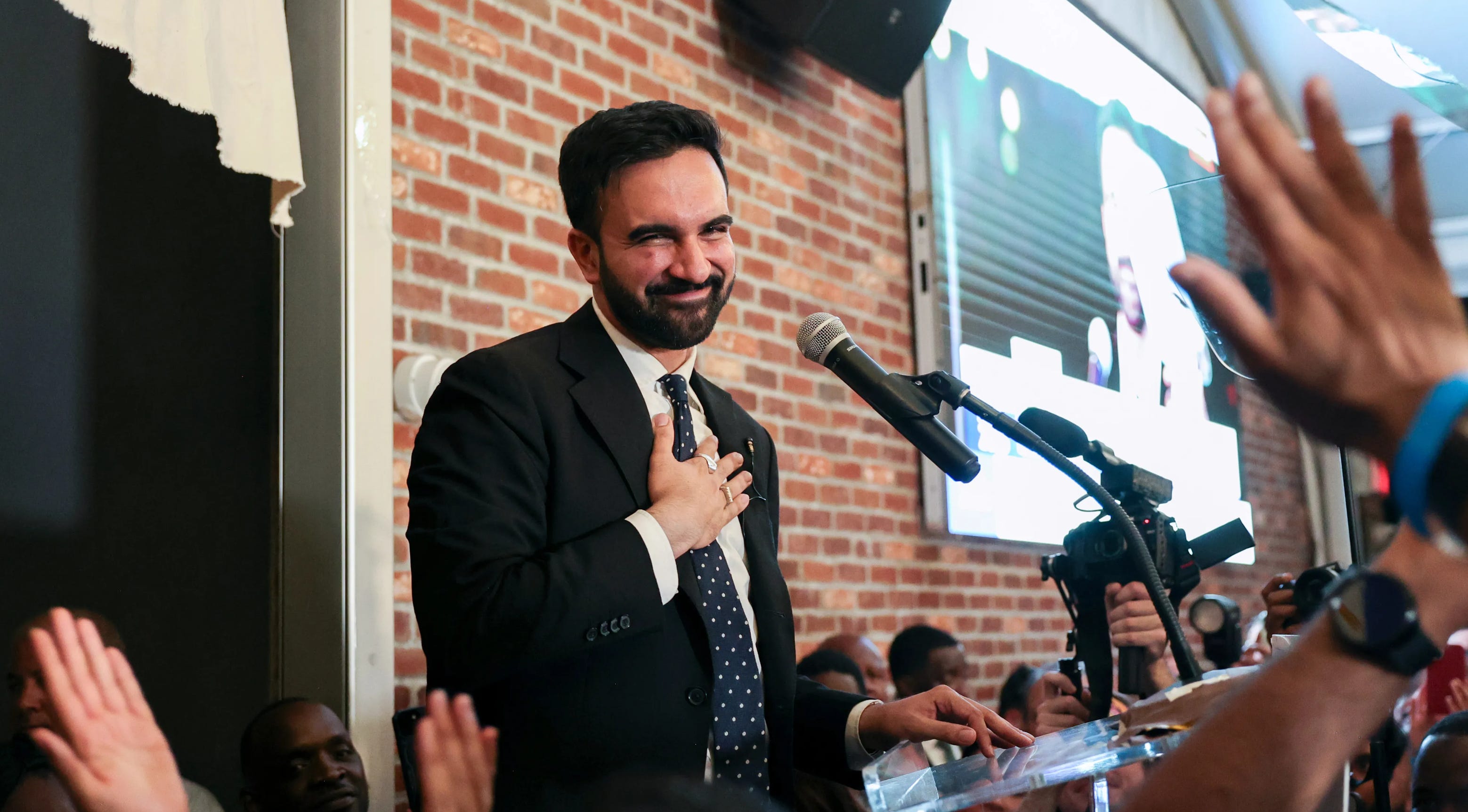
Zohran Mamdani—the favored candidate for mayor of the City Formerly Known as New York—is not a politician. He is an actor. He is not even a good actor. But the winsome, fresh-faced 34-yeard old hits all the right notes, and manufactures all the right emotions. He projects all the necessary romanticism pined for by a bruised and battered bluegeoisie.
Given such theatrics it’s natural that Mr. Mamdani would be championed by the entertainment community: Jon Stewart compared him to Jackie Robinson; actor Mandy Patinkin released a gushing video endorsement; the Actor’s Equity Association—beleaguered union for stage actors—endorsed Mamdani months ago.
The orgy of adulation for Mr. Mamdani by New York’s entertainment professionals reveal they’ve learned nothing over the last decade (and they’ve still never quite recovered from—much less taken accountability for—the bad decisions made in 2020).
Sadly there’s no shortage of slop coming from anti-Mamdanians, certain that he’ll force niqabs onto the woke white women who adore him. But there’s no need for such buffoonish demagoguery.
All that’s needed is a brief examination of key policy proposals to understand why his mayoralty will be a blight on the Big Apple—and a catastrophe for the cultural workers blindly supporting him.
ON AFFORDABLE HOUSING.
The heart of Mr. Mamdani’s campaign is New York’s ballooning cost of living.
Top of this agenda is “affordable” housing.
As a “Democratic” Socialist, Mamdani’s proposals reflect the presumption that heavy intervention from the “public sector” (the state) is key in solving New York’s mounting problems. Immediately a question arises:
Do entertainment professionals, self-avowed #Resistance to authoritarian governance, fail to see the irony in electing a mayor whose platform explicitly revolves around expanding state power?
Even if Mr. Mamdani’s policy proposals were wise, they would require an efficient state apparatus free from bloat and waste to affect meaningful change. But here another issue arises:
Mr. Mamdani proposes spending $100 billion dollars over 10 years to build 200,000 “affordable” housing units while freezing private development until certain “affordability” metrics are met. Leaving aside the conveniently vague definition of “affordability”, New York’s existing public housing projects already have a staggering backlog of repairs totaling $78,000,000,000 across more than 177,000 units. Thus another question arises:
Adding 20,000 new units annually for a decade may enrich union workers and contractors—but how does it help New Yorkers already languishing in deteriorating public housing?
And yet deteriorating living arrangements, even those not in subsidized housing, are a feature and not a bug in a cornerstone of Mamdani’s campaign on housing, that being rent stabilization.1
Such policies benefit some in the short term. But tenants are incentivized to cling to rent-stabilized spaces, creating lower turnover; lower turnover means fewer vacancies; fewer vacancies mean less new construction; less construction + lower turnover = lower supply, and higher prices for fewer available units.
Ironically, despite Mamdani’s intention to benefit working people and penalize the rich, his housing policies will likely have the opposite effect, creating scenarios like the following:
“Leo Katz, a 27-year old acting student and doorman, rents a small studio apartment on Manhattan’s Upper West Side for $1200—with two roommates. Two sleep in separate beds in a loft built atop the kitchen, the third on a mattress in the main room.
Across town on Park Avenue, Paul Haberman, a private investor, and his wife live in a spacious, two-bedroom apartment with a solarium and two terraces. The apartment in an elegant building on the prestigious avenue is worth at least $5,000 a month, real estate professionals say. The couple pay around $350, according to rent records.” 2
The problems with rent controls are neither unique to New York, nor to the United States:
San Francisco’s rent control policies contributed to higher rents, lower housing supply, and gentrification (another bane of left-wing politics).
In Berlin, a recent rent freeze moved landlords to withdraw properties from the market, reducing housing options and forcing out-migration to neighboring cities.
In Stockholm, Sweden’s long-entrenched rent control has created an average wait time of nine years for a rent-controlled property (a scenario that actors in New York are intimately familiar with).
By contrast, when Cambridge, Massachusetts ended rent control in 1995, it saw the overall valuation of its housing stock increase by $1.8 billion from 1994 – 2004. Within four years Cambridge saw new housing and construction increase by 50%. Tax revenues from construction permits tripled.
As Mr. Mamdani’s platform calls for more aggressive tax collection, he might bear such results in mind.
MINIMUM WAGE
It’s a balmy summer evening in upper Manhattan.
I’m on a munchies-driven (and guilt-ridden) mission for a Bacon McDouble cheeseburger and a large fry.
I eavesdrop on three young Latinos in McDonald’s uniforms, commiserating in front of the restaurant during a smoke break. In accented English they complained amongst each other of hours being cut, of shifts disappearing, and of earnings vanishing.
One of the men, after a long pull on his cigarette, sighed with a resigned sarcasm:
“Fifteen dollar minimum wage.”
New York’s $15 minimum wage law had passed just months before.
People aren’t stupid. An individual doesn’t need to grasp basic economic principles to understand the trade-off between higher base pay and diminished economic advancement. He must live that trade-off, while the bluegeois Progressives gleefully passing (or endorsing) such legislation will not.
The impact doesn’t stop at employees, but also affects consumers in the form of higher prices.
Paying 25 cents more for a cheeseburger may have meant nothing to privileged legislators, but surely it meant something to the teens who swarmed the restaurant after school, to the elderly patrons living on fixed incomes, to the homeless who’d scraped enough dimes together for a meal, and to low-income parents seeking to feed their children.
Again, one need only look at the consequences of the $20 minimum wage law recently imposed in California, which led to an estimated 16,000 job losses in the fast food sector, and price increases of 14.5% (compared to a national average of 8.2%).
Zohran Mamdani wants to raise the minimum wage to $30 per hour.
If one is to judge future impact by past results, the perennially unemployed actor scrambling for a survival job will see himself priced out of a shrinking market in what is already one of America’s most relentlessly competitive economies.
EPILOGUE
The vulnerability of the artist is a blessing and a curse.
It enables them to more easily align with those they perceive as marginalized by society—and indeed, artists themselves are routinely marginalized in our utilitarian, commodity-driven world. But the same openness that inspires their work leaves them susceptible to swindle by nonsensical policy.
The sensible person might wonder how abolishing bus fares will lead to safer and faster bus service, rather than to overcrowding by the kinds of people they know to avoid on the subway. The sensible person might then question Mamdani’s commitment to “public safety,” given the progressive left’s well-documented disdain for law enforcement and criminal justice measures.
The sensible person might also wonder how Mamdani’s plan to restore NYC’s “Sanctuary City” status for immigrants—which will impact multiple sectors from housing to employment to crime to government subsidies to, yes, traffic and transit—will make an already dense and diverse city “better” for struggling native New Yorkers.
But artists are sensitive, not sensible. And entertainment professionals (actors in particular) are even less so.
And when their cost of living continues to rise while their standard of living continues to decline, they’ll never connect their utopian voting to their deteriorating reality.
As always, they’ll trot out the same tired excuse:
“Trump did this.”
CD
Not only is the supply of new apartment construction less after rent control laws are imposed, even the supply of existing housing tends to decline, as landlords provide less maintenance and repair under rent control, since the housing shortage makes it unnecessary for them to maintain the appearance of their premises in order to attract tenants. Thus housing tends to deteriorate faster under rent control and to have few replacements when it wears out. Studies of rent control in the United States, England, and France have found rent-controlled housing to be deteriorated far more often than non-rent-controlled housing. Thomas Sowell, Basic Economics (2015, Basic Books).
Laurie P. Cohen, “Home Free: Some Rich and Famous of New York City Bask in Shelter of Rent Law,” Wall Street Journal, March 21, 1994, p. A1. (Citation taken from Thomas Sowell’s Basic Economics.)
Very well written and well reasoned. My general comment is one of my life axioms, which is that leftists never learn. They have no interest in learning. They would rather complain that the grownups aren’t doing things right.
My more specific comment is about Mamdani’s “affordable housing” fantasies. He thinks he’s going to build 20,000 units for $100 billion? My partners and I were, for three decades, the largest affordable housing developers in two Western states, and smaller players in the industry in four other states. We’re still building and buying around the country, though mostly Southeast these days. We know a little about it. Three- and four-story wood frame apartments cost north of $500,00 per unit to build anywhere in the West (all blue states, of course) and more like $750,000 and even more in many places. In cities like Atlanta it’s at least $500,000/unit. So, how much is the cost in NYC? I don’t know, but I’d be shocked if it’s not substantially higher, and that’s for low rise wood frame. Is that what Mamdani thinks they’ll build? Because mid- and high rise is way more expensive. And that’s today, not 5-10 years from now. And in NYC it would take years just to fight through the approval process before you could break ground.
Mamdani has no idea what he’s talking about. Of course, since he’s never actually created any housing, or done anything else. Like bloviating governors in other blue states who make grand pronouncements about their affordable housing goals that never come close to being realized, he’s an “activist,” which means he talks but never actually does, creates or builds anything. And, being a leftist, never learns anything either.
"Every socialistic type of government … produces bad art, produces social inertia, produces really unhappy people, and it's more repressive than any other kind of government." – Frank Zappa ("My Afternoon with Frank Zappa," by Larry Rogak, May 8, 1980)